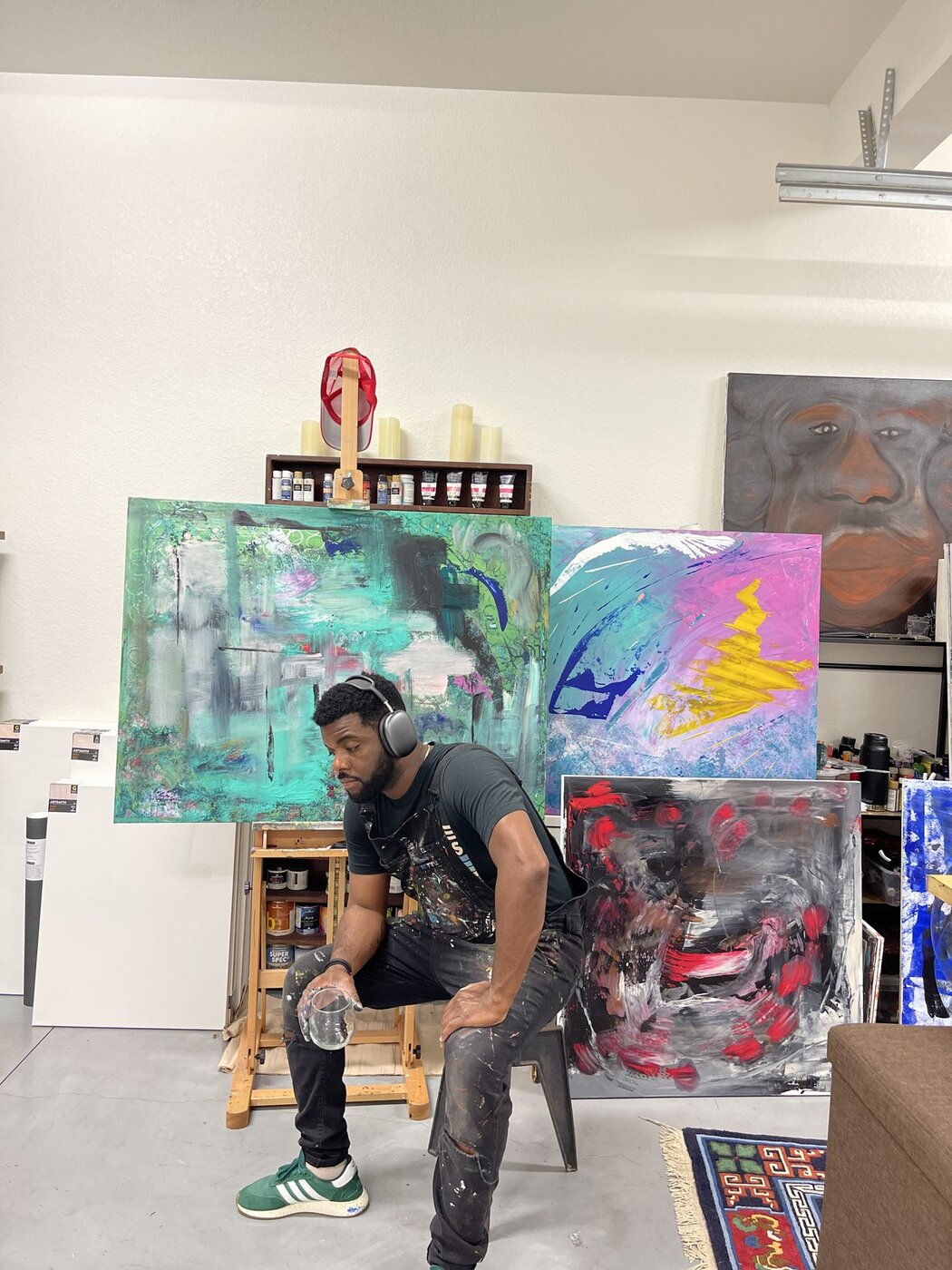
Robert
Hightower
Self-taught painter. Bay Area, California. Started making art in 2021 and hasn't stopped. Through everything that came with that, and everything that followed.
Robert Hightower began painting in 2021. Not as a career move, not as a hobby, but as the only honest response he had to what he was carrying. He had no formal training, no art school, no mentor. He had a canvas, black paint, and the particular freedom that comes with having nothing to prove to an institution.
The early work was black and white. That was not a stylistic choice. It was the only honest thing he could make. Black and white is what it looks like when you are holding everything in. For four years, while he showed that work in galleries across the Bay Area, several solo shows, press coverage, collector interest, a grant from Bader + Simon Gallery in Cincinnati, he was also doing the harder work: four years of therapy, the kind that strips everything down before it builds anything back up.
In 2025, he stepped away from making art entirely. He built an app, something with nothing to do with painting, and in doing so gave his creative mind room to breathe for the first time since 2021. To stop producing and start feeling again. The distance was not abandonment. It was necessary.
When he returned to the studio, color arrived. Not as a decision. As a consequence. The chairs and benches and tables that fill this new body of work: these were not chosen from a palette so much as released from whatever had been holding them back. Color is what healing looks like.
Moving forward under his full name, Robert Hightower, not a handle, not an alias, is itself part of the work. It is the decision of someone who no longer needs the protection of a persona, who is willing to stand in front of what he makes and say: this is mine, and I made it on purpose.
The upcoming exhibition A Seat at the Table at Bader + Simon Gallery in Cincinnati is the culmination of this arc. Twenty-six new paintings, all built around the same object - a chair, a bench, a table, a room made to hold someone who may or may not be there. It is not a retrospective. It is a reckoning. The title says what needs to be said: he has arrived, and he has earned his place at it.